
Why Most CRMs Don’t Increase Revenue—and What High-Growth Companies Use Instead
Key Points
- White Glove CRM service provides a comprehensive, done-for-you implementation, making it a great fit for businesses with limited technical resources or time.
- Self-Serve CRM options give you control and provide training resources and templates, ideal for hands-on teams who value the ability to customize.
- The real difference in cost between implementation options goes beyond monthly fees and includes time investment, learning curve, and revenue opportunities.
- Most businesses can switch between White Glove and Self-Serve approaches as their needs change over time.
- According to top CRM implementation experts, choosing the right service model can cut implementation time by up to 70%.
The approach you take to implementing your CRM may be the single most important factor in the success of your system. While many businesses only consider features and pricing when choosing a CRM, the method of implementation often determines whether your investment pays off in a big way or just becomes another tool that isn’t fully utilized.
The Importance of a Solid CRM Implementation Strategy
CRM systems are capable of enhancing customer relationships, increasing revenue, and making operations more efficient – but only if they’re implemented correctly. Even the most sophisticated platform is useless if it’s not used or set up properly. According to CRM implementation experts, the difference between a successful CRM system and a failed one often comes down to the implementation strategy.
When it comes to getting your CRM system operational, most providers present two main avenues: a White Glove service that handles all implementation for you, or a Self-Serve option that allows you to set up the system yourself using training materials. It’s important to understand what each of these methods entails before you decide which one to go with.
Ultimately, the right choice depends on your business’s unique mix of technical skills, available time, budget limitations, and specific needs. Let’s take a closer look at both options so you can make an informed decision that aligns with your organization’s resources and goals.
White Glove CRM Service: Comprehensive Implementation Without Lifting a Finger
The White Glove service is the top-tier path for implementation, where CRM professionals take care of everything from the first setup to continuous improvement. It’s like having your own team that turns your vision of customer management into a working reality – without your team needing to become software gurus in a flash.
Complete Construction and Arrangement by CRM Professionals
When you opt for White Glove service, the task of constructing your complete CRM ecosystem from scratch falls to implementation experts. They take care of configuring the database, setting up workflow automation, creating custom fields, and integrating with your current tools. This method greatly alleviates the technical load on your team while guaranteeing that your system adheres to best practices from the outset.
Continued Maintenance and Improvement
The benefits of White Glove don’t stop at setup. You’ll have dedicated experts on hand for system upkeep, problem solving, and continued improvement as your business grows and changes. This ongoing relationship means your CRM will keep up with your ever-changing business needs without requiring a lot of your internal resources. If there are problems or new features are released, your implementation team will be on top of it before it impacts your business.
Consulting and Designing Workflow
White Glove service’s most valuable feature is probably the strategic expertise that comes with the technical execution. CRM experts work with your team to understand your business processes, identify inefficiencies, and design workflows that address real operational challenges. This consultative approach turns CRM from just a contact database into a strategic business tool that creates significant improvement.
“The difference between White Glove and Self-Serve is in the level of support and implementation—Self-Serve gives you the tools and training to run it yourself, while White Glove includes complete done-for-you setup, customization, and ongoing strategic consulting.”
Ideal Business Profiles for White Glove Service
White Glove implementation typically makes the most sense for businesses with limited internal technical resources, time constraints, or complex CRM requirements. Organizations experiencing rapid growth often benefit from this approach, as it allows them to implement sophisticated systems without diverting focus from core business activities. Similarly, businesses with past failed software implementations may find the guided approach prevents repeating previous mistakes.
Businesses that value quick results over saving money tend to prefer White Glove service. When you consider the opportunity cost of a long DIY implementation (usually 40-100+ initial hours plus ongoing management), many businesses find that the higher service level makes more economic sense, despite the higher price tag. For some insights on avoiding common pitfalls, explore small business CRM failures and how to set your business apart.
Self-Serve CRM: Managing Your Customer Relationships Your Way
With Self-Serve CRM, your team is in control of the system set up and management. This means you can create a highly personalized solution that fits your organization’s needs without having to pay for ongoing support. To avoid common pitfalls, learn from small business CRM failures and ensure your system is set up for success.
Platform, Template, and Training Access
When you choose a Self-Serve option, you usually get full access to the CRM platform, along with pre-made templates and a wealth of training materials. These resources include video tutorials, documentation, and configuration guides that will guide your team through the setup process one step at a time. This allows teams that are technically savvy to implement complex solutions without the need for external expertise.
Do-it-Yourself Setup and Administration
When you opt for a Self-Serve setup, your team is in the driver’s seat. You’ll be in charge of creating workflows, setting up automation, and structuring the system. This method gives you the most flexibility to try different things, make adjustments, and customize your CRM to meet your exact needs. If your organization knows what it wants and has some technical skills, this approach gives you the freedom to customize without having to stick to a schedule set by an outside company.
Support Resources at Your Disposal
Even though Self-Serve doesn’t come with a done-for-you implementation, it doesn’t mean you’re left to fend for yourself. Most Self-Serve options provide access to email support, knowledge bases, community forums, and troubleshooting resources. These support channels offer a lifeline when you encounter issues during implementation without the price tag of full-service support. Some providers also offer consultation hours on a pay-as-you-go basis for particularly complex configuration issues.
What Businesses are Suited for Self-Service?
Self-Service CRM implementation is a great fit for businesses that have dedicated technical resources, a clear plan for implementation, or previous CRM experience. If your team members enjoy learning new systems and have the bandwidth to manage the implementation, this approach can be both cost-effective and empowering. Businesses that value having a lot of control over customization and have the capacity to dedicate 5-10+ hours a week to managing the system will likely do well with a Self-Service model.
Businesses with simple CRM needs or those with plans to implement it in stages may find that Self-Serve offers the perfect combination of functionality and cost efficiency. The critical factor for success is to have a realistic understanding of the time needed for proper setup and continuous management.
5 Key Considerations for Choosing the Right CRM Approach for Your Business
1. Your Team’s Technical Skills
Before you choose a CRM approach, you need to honestly evaluate the technical skills of your team. If your team is comfortable learning new software, understands basic database concepts, and can troubleshoot occasional technical issues, then the Self-Serve approach can be successful. However, if your organization doesn’t have dedicated technical resources or if your team is already struggling with existing technology, then the White Glove approach, despite its higher cost, can provide better results because it includes technical expertise.
2. Time Required for Implementation
Setting up a CRM system takes a lot of time, especially at the beginning. If you choose the Self-Serve option, you should expect to spend 40-100+ hours on the initial setup and then 10-20 hours every month on management and optimization. Companies need to think about whether they can afford to spend this much time on a CRM system without neglecting their main business activities. If you choose the White Glove option, the service provider will take care of the technical setup for you. This will save you a lot of time and allow you to concentrate on making strategic decisions for your business instead of worrying about how to set up the system.
3. Financial Factors and Return on Investment Timing
Even though White Glove services are more expensive than Self-Serve options, the real cost comparison goes beyond the monthly subscription fees. Companies must think about the opportunity cost of internal resources, the effect of implementation delays, and the potential revenue increases from quicker system deployment. Self-Serve options usually have lower direct costs but need more internal resource investment. Companies that prioritize a quicker time-to-value often find that White Glove services provide a better overall return on investment despite the higher initial costs because they speed up implementation timelines by weeks or even months.
4. The Complexity of the System and Integration Needs
The complexity of a CRM system plays a large role in determining the best method of implementation. Basic contact management systems with little automation can usually be implemented just fine with a Self-Serve approach. However, more complex systems with a lot of workflow automation, custom field requirements, or multiple third-party integrations are usually better off with a White Glove implementation.
Integration complexity often ends up being a deciding factor. Linking your CRM with existing business tools, payment processors, marketing platforms, and other systems requires technical expertise that may be beyond your team’s capabilities. White Glove services are often better equipped to handle these integration challenges because they have specialized experience and established integration pathways.
5. Long-term Goals and Scalability Needs
When deciding on a CRM implementation method, it’s important to consider your company’s long-term goals and growth plans. If your company is growing quickly, a White Glove service might be the best choice. These services can scale up quickly to meet your growing needs. They also provide expert advice to make sure your CRM system is set up to support future growth without having to be completely rebuilt. On the other hand, if your company’s operations are steady and your needs are predictable, a Self-Serve option might be more cost-effective in the long run and still provide the scalability you need.
Price Comparison: The Real Investment Beyond the Sticker Price
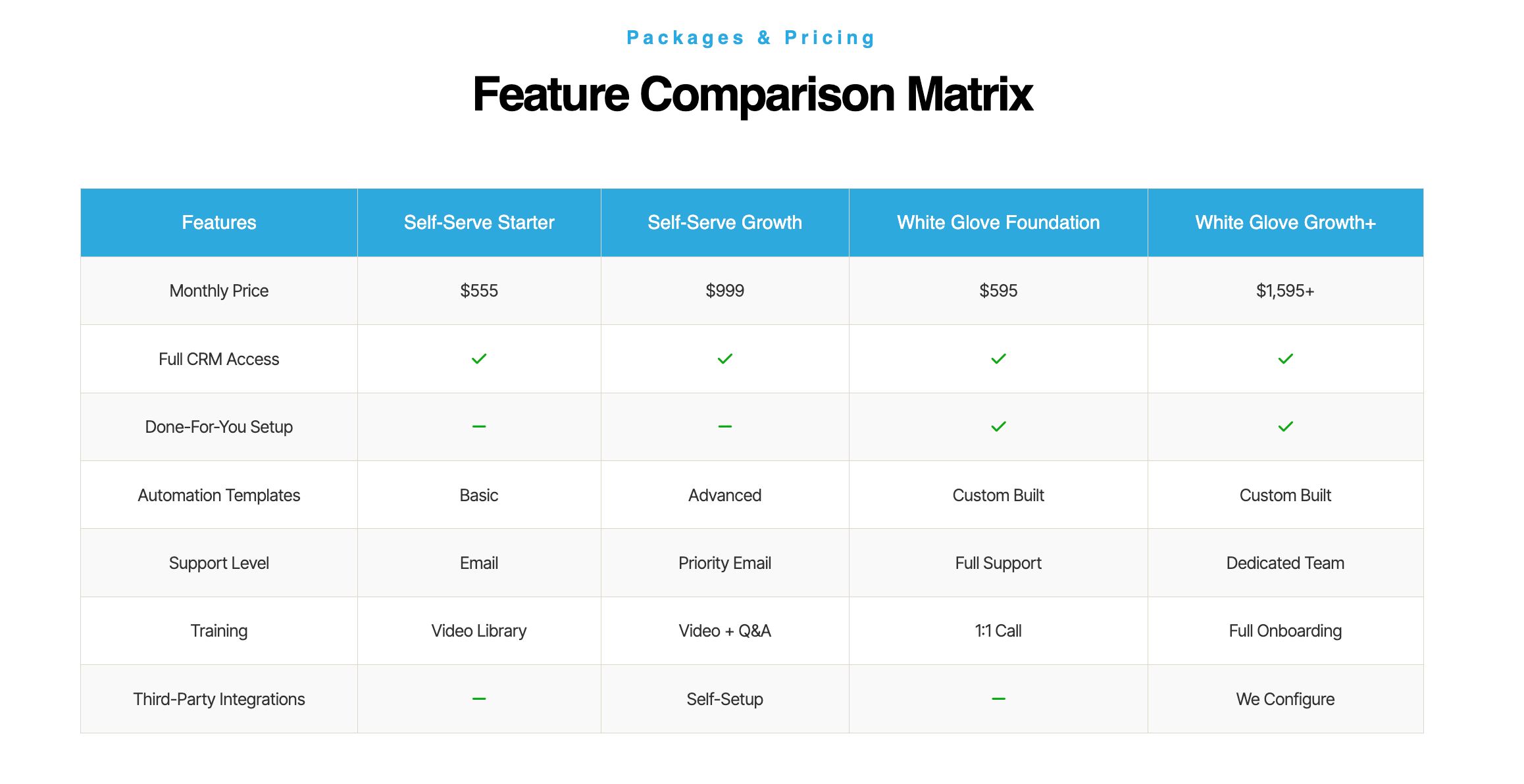
The cost comparison between White Glove and Self-Serve goes much further than the monthly subscription fees. Savvy businesses assess the full cost picture, which includes direct expenses, internal resource allocation, opportunity costs, and the timing of revenue impact.
White Glove services generally begin at a monthly cost of $1,595, while Self-Serve options usually start at a slightly lower $555/month. But this simplistic price comparison doesn’t reflect the full financial implications of your choice of implementation. To get an accurate picture of the investment you’re making, you need to consider all the factors that affect the total cost of ownership and the timing of the return on your investment.
- Immediate monthly subscription fees
- Internal staff time measured at appropriate hourly rates
- Opportunity cost of delayed roll-out
- Revenue impact timing differences
- Costs associated with training and knowledge acquisition
When taking these factors into account, many businesses find that White Glove services offer better financial results even though they have higher subscription fees. The efficiency of professional roll-out often offsets the higher price through faster deployment, less need for internal resources, and quicker revenue improvement.
The Hidden Price of Do-It-Yourself Implementation
Implementing a CRM system yourself carries a lot more hidden costs than just the time it takes to do it. Many businesses underestimate how much they will have to learn, which can lead to configurations that aren’t the best and need to be redone later. When teams that don’t have a lot of experience implement temporary solutions, they can end up creating more work for themselves later when they have to redo it the right way. On top of that, if the workflows created during the implementation aren’t efficient, it can lead to inefficiencies in operations that can quietly take away from productivity for months or even years.
Probably the most substantial hidden cost is the lost opportunity cost of not realizing value sooner. Every week spent grappling with implementation equates to lost revenue from better customer management, missed sales opportunities, and ongoing operational inefficiencies. These indirect costs often far outweigh the apparent savings from opting for self-service.
Comparing Time-to-Value and ROI
White Glove CRM deployments are typically up and running 60-75% faster than self-serve options. This means you can start seeing a return on your investment and a competitive edge sooner. While a self-serve CRM may eventually offer the same functionality, the extra months of value you get from a professional deployment often make the higher cost worth it.
When calculating return on investment, you must also take into account the quality differences in the solution that has been implemented. Professional implementations will usually include best practices, optimization techniques, and efficient workflows that could take self-serve users months or even years to discover on their own. These quality differences build up over time, further increasing the ROI gap beyond just the initial implementation speed advantages.
Getting the Best of Both Worlds: Hybrid Approaches
Hybrid implementation strategies often deliver the best results for many organizations because they combine elements from both approaches. These flexible models enable businesses to allocate resources strategically based on internal capabilities, time constraints, and budget considerations. This way, they can still achieve professional-quality implementations.
Beginning with White Glove, Shifting to Self-Serve
A common mixed strategy starts with White Glove setup to build a robust base, then shifts to Self-Serve for continuous control and improvement. This plan offers quick initial rollout through expert setup while nurturing in-house abilities for lasting system management. Businesses obtain instant benefits from professional setup while acquiring the expertise to sustain and expand their system autonomously over time.
Organizations with limited immediate technical capacity but plans to develop internal capabilities can greatly benefit from this transition approach. The knowledge transfer process becomes more practical when staff can learn within the context of an already-functioning system rather than simultaneously building technical skills and implementing from scratch. For those looking to streamline their tools, consider the all-in-one system that local businesses are quietly switching to.
Outsourcing Complex CRM Features, Keeping Simple Tasks In-House
A different hybrid model that works well involves outsourcing complex CRM features to professionals while keeping simple tasks in-house. Your organization might hire implementation specialists for things like sophisticated automation development, complex integrations, and system architecture, while keeping day-to-day operations like user administration and basic workflow adjustments in-house. This selective outsourcing approach ensures that you’re allocating resources optimally by focusing expert assistance where it delivers the most value. To understand what sets successful CRM systems apart, consider exploring the insights from small business CRM failures.
The hybrid model offers the best of both worlds by providing cost efficiency and quality implementation through resource allocation. Technical experts tackle complex issues that require deep knowledge, while in-house teams handle regular operations that benefit from company-specific knowledge. This balanced approach often provides better results than either pure implementation model. For more insights on optimizing business operations, explore the enterprise operations secret used by Fortune 500 companies.
Adjusting Service Levels Based on Milestones
Many businesses choose to adjust their service levels based on implementation stages or periods of business growth. For example, a company might start off with full White Glove support during the initial setup and training phase, move to less support during regular operation, and then temporarily ramp up support during significant system expansions or integrations. This flexible approach matches support resources to actual needs, instead of locking into one implementation model for the long term.
Concrete Examples: Successful Implementation Stories
The abstract differences between implementation methods become tangible when looking at real-life results. Companies from all sectors have seen incredible outcomes through both White Glove and Self-Serve implementations, even though their paths and timelines often differ greatly.
White Glove Transformation: From Chaos to Clarity
A growing professional services firm found themselves struggling with fragmented customer data and inconsistent processes. They chose to use White Glove implementation after failing to implement various CRM solutions on their own. Their implementation specialist conducted a thorough analysis of their processes, designed custom workflows to match their unique service delivery model, and implemented comprehensive automation that eliminated the need for manual data entry. The specialist also created executive dashboards that provided them with unprecedented visibility into their sales pipeline and client retention metrics.
After just a month and a half, the company had fully migrated to the new software without needing to invest much time internally. In the first three months, revenue attribution shot up 42% as opportunities that had previously been missed were now being systematically recorded and monitored. Client retention saw a 23% boost thanks to automated follow-up sequences and more consistent delivery of services. Above all, the company’s leaders finally had accurate forecasting capabilities, which allowed them to plan for growth with confidence. Discover how switching to an all-in-one system can streamline operations and enhance business performance.
Self-Serve Win: Crafting the Ideal Customized System
A tech startup boasting robust internal technical skills opted for the Self-Serve implementation route to design a CRM that was highly tailored and perfectly in sync with their unique customer journey. The product manager of the company dedicated roughly 80 hours over a span of two months to fully understand the platform, construct custom objects that tracked their specific metrics, and create automation that supported their consultative sales method. For insights on avoiding common pitfalls, check out 73 small business CRM failures.
Although the setup process was quite time-consuming, the resulting system offered a competitive edge because it was perfectly aligned with their unique sales process. The team valued having total control over the order of implementation and the ability to constantly improve their system based on new needs.
- Perfect fit with your unique business processes
- Creation of custom sales workflows that aren’t available in out-of-the-box solutions
- Ability to make iterative improvements without incurring additional service fees
- Deep understanding of the system gained through hands-on implementation
The startup’s CTO later mentioned that while it took longer to implement than anticipated, their in-depth knowledge of the system architecture allowed them to make ongoing optimizations more efficiently than if they had outsourced the implementation. The time they invested resulted in valuable intellectual property in the form of business process automation that directly supported their competitive strategy.
Both organizations had successful implementations, even though they chose different methods. The professional services firm wanted to get it done quickly without taking too many internal resources away, while the technology startup wanted to have a lot of control over customization and build up their knowledge. The best choice was the one that matched the resources, capabilities, and priorities of each organization.
Both Methods Boost Essential Metrics
Although the implementation processes and timelines for White Glove and Self-Serve CRM options are quite different, both methods can lead to substantial improvements in crucial business metrics. Companies that have adopted either of these approaches have reported substantial increases in lead conversion rates, customer retention rates, and operational efficiency, as well as a reduction in the length of sales cycles.
The main difference is not so much in what can be achieved, but how long it takes to get there. White Glove implementations are usually fully up and running 3-6 months faster than Self-Serve implementations. This is because they have a more intensive deployment schedule and they are professionally optimized. However, if a Self-Serve team is committed and puts in the resources, they can achieve the same results. It just takes them longer.
Choosing the Right CRM for Your Business
Choosing the right CRM for your business involves a deep dive into your organization’s resources, capabilities, and priorities. Start by taking a hard look at your team’s technical skills and the amount of time they can realistically dedicate to the project. Take into account your implementation timeline and how soon you need to start seeing a return on your investment. Lastly, you’ll want to calculate the total cost, including both direct costs and the opportunity costs that come with different implementation speeds. The best approach for you will depend on your specific circumstances, not on general advice.
Commonly Asked Questions
Companies considering CRM implementation strategies often have similar questions about the practical implications of each option. Comprehending these subtleties can help ensure that your decision meets your specific business needs and abilities.
|
Implementation Factor |
White Glove Approach |
Self-Serve Approach |
|---|---|---|
|
Typical Implementation Timeline |
2-6 weeks |
2-4 months |
|
Internal Resource Requirement |
5-10 hours for requirements/feedback |
40-100+ hours for implementation |
|
Technical Expertise Needed |
Minimal (can articulate needs) |
Moderate (comfortable learning software) |
|
Ongoing Management Time |
1-2 hours weekly |
5-10+ hours weekly |
The table above illustrates typical resource requirements and timelines for each implementation approach. These factors significantly influence which option makes the most sense for different organizational profiles and business objectives.
Aside from these basic differences, there are often specific queries about switching between services, technical requirements, and support options that come up during the decision-making process. Grasping these subtle differences can assist businesses in choosing the path that best suits their unique circumstances.
We’re going to tackle the most frequently asked questions about implementation strategies to give you a clear picture for your decision-making process.
Is it possible to switch between White Glove and Self-Serve after I’ve started?
Indeed, the majority of CRM providers allow for back-and-forth transitions between service levels. It’s common for businesses to start with White Glove implementation to set a strong foundation, and then switch to Self-Serve once their system is stable and their team has the necessary management skills. On the other hand, businesses that start with Self-Serve often upgrade to White Glove when they encounter complex integration issues or during periods of fast growth. Since the underlying platform stays the same, the transition process usually only requires minor system changes.
What is the usual time frame for implementation for each option?
White Glove implementations usually reach full deployment in 2-6 weeks, depending on the complexity of the system, integration needs, and data migration requirements. This fast-paced schedule is due to the dedicated implementation specialists who work effectively with established procedures and templates.
Usually, it takes 2-4 months to implement self-serve to the same level of functionality. The reason for this extended period is the learning curve, trial-and-error processes, and other priorities that most internal implementation teams have to deal with. If an organization can dedicate a lot of focused resources, they might be able to implement self-serve faster, but it would require a high level of commitment and technical skill. For insights on avoiding common pitfalls, check out what sets successful CRM systems apart.
What technical skills do I need to successfully use a self-service CRM?
For a successful self-service CRM, your team members need to be comfortable learning new software interfaces, understand basic database concepts, and be able to troubleshoot technical issues systematically. While knowing how to code is not usually necessary, having logical thinking and process mapping skills can greatly increase the chances of successful implementation. Your team members should be able to follow technical documentation, apply templates to specific business scenarios, and make adjustments based on testing results.
Aside from technical skills, Self-Serve implementation requires a strong project management approach to keep the project moving forward despite other pressing issues. The team implementing the system must carefully document all decisions made, maintain consistency in configuration, and follow a systematic testing process to ensure the system operates reliably.
Companies considering the Self-Serve option need to honestly assess whether their team members have the technical know-how and the time to manage the implementation successfully. The main reason why Self-Serve implementations fail is because they underestimate the technical learning curve or the time commitment that is needed.
Even if your team is technically adept, you’ll need patience and determination to navigate the inevitable roadblocks that come with implementation. The ability to systematically identify problems, seek out solutions, and apply fixes without getting discouraged is what separates successful Self-Serve implementers from those who find it difficult.
“For Self-Serve: You should be comfortable learning new software. Our video training and templates guide you through everything. For White Glove: No technical skills needed. We do all the work.”
Does White Glove service include training my team?
Yes, comprehensive White Glove service includes both initial system setup and thorough team training. Implementation specialists typically develop custom training materials addressing your specific configuration and business processes rather than generic platform instruction. This tailored training approach helps team members understand not just how features work technically but how they support your unique operational requirements. For more insights on effective CRM implementation, check out the article on small business CRM failures.
One of the most beneficial parts of White Glove service is the training component, which merges technical teaching with strategic advice on the best way to use the system. Implementation specialists provide a background for configuration decisions, explain the principles of automation design, and share the best practices for your industry and use case. This transfer of knowledge allows your team to use the system effectively, even without a deep technical understanding of the underlying configuration.
Can I see what’s going on with my system with White Glove service?
- Total visibility into system setup and automation rules
- Documentation of all setup decisions and technical structures
- Regular updates throughout the setup process
- Sessions to transfer knowledge explaining key system components
- Administrative access to all system elements
White Glove setup provides full transparency and visibility rather than creating dependency through hiding information. Setup specialists document their work thoroughly, explain the reasoning behind setup decisions, and ensure your team understands system architecture. You maintain complete ownership of your system while benefiting from professional setup expertise.
Companies often fear that White Glove implementation may lead to a reliance on the vendor due to unclear configuration or restricted access. In truth, professional implementation actually improves your control by establishing well-organized, fully documented systems that continue to be maintainable even if you eventually switch to Self-Serve management. The difference is in who carries out the implementation work, not in system clarity or accessibility.
Several companies have discovered that White Glove implementation can actually boost their long-term autonomy by setting up appropriate foundations and documentation habits from the start. Clean initial implementation can help to avoid the technical debt that frequently builds up during self-implementation and ultimately needs professional assistance to fix.
In the end, the decision to go with either White Glove or Self-Serve implementation should be based on your company’s unique resources, capabilities, and priorities, not on general advice. By fully understanding each option’s implications – including timelines, resource needs, and long-term maintenance issues – you can make sure your choice fits with your business goals and restrictions. For insights into why some small business CRM solutions fail, consider exploring additional resources.
Tags:
Share:
